arxiv
Critical Evaluation of Studies Alleging Evidence for Technosignatures in the POSS1-E Photographic Plates
Recent studies by B. Villarroel and colleagues have assembled and analyzed datasets of unidentified features measured from digital scans of photographic plates captured by the first-epoch Palomar Observatory Sky Survey (POSS1) in the pre-S…
Relaying Signal When Monitoring Traffic: Double Use of Aerial Vehicles Towards Intelligent Low-Altitude Networking
In intelligent low-altitude networks, integrating monitoring tasks into communication unmanned aerial vehicles (UAVs) can consume resources and increase handoff latency for communication links. To address this challenge, we propose a strat…
The Flying Saucer edge-on disc's Near Infrared silhouette revealed by the JWST JEDIce program
Edge-on discs offer a unique opportunity to probe radial and vertical dust and gas distributions in the protoplanetary phase. This study aims to investigate the distribution of micron-sized dust particles in the Flying Saucer (BKLT J162813…
Edge-On Disk Study (EODS) III: Molecular Stratification in the Flying Saucer Disk
Context: Investigating the vertical distribution of molecular content in protoplanetary disks remains difficult in most disks mildly inclined along the line of sight. In contrast, edge-on disks provide a direct (tomographic) view of the 2D…
Flow Matching-Based Active Learning for Radio Map Construction with Low-Altitude UAVs
The employment of unmanned aerial vehicles (UAVs) in the lowaltitude economy necessitates precise and real-time radio maps for reliable communication and safe navigation. However, constructing such maps is hindered by the infeasibility of …
The deployment of a geomagnetic variometer station as auxiliary instrumentation for the study of Unidentified Aerial Phenomena
Witness reports of Unidentified Aerial Phenomena (UAP) occasionally associate UAP sightings with local electromagnetic interferences, such as spinning magnetic compasses onboard aircraft or sudden malfunctions of mechanical vehicles. These…
Edge-On Disk Study (EODS) II: Thermal Structure of the Flying Saucer Disk
Context. The dust and gas temperature in proto-planetary disks play critical roles in determining their chemical evolution and influencing planet formation processes. Aims. We attempted an accurate measurement of the dust and CO temperatur…
Galileo Project Observatory Class System Architecture
Scientific investigation of Unidentified Anomalous Phenomena (UAP) is limited by poor data quality and a lack of transparency. Existing data are often fragmented, uncalibrated, and missing critical metadata. To address these limitations, t…
Computational Complexity of UAP Reverse Engineering: A Formal Analysis of Automaton Identification and Data Complexity
This white paper demonstrates that reverse engineering Unidentified Aerial Phenomena (UAP) is NP-complete under classical computational paradigms. By modeling UAP reconstruction as an automaton identification problem with a state character…
Unidentified Aerial Phenomena. Characterization of Dark UAPs
We use high-tech observations of Unidentified Aerial Phenomena (UAP) class objects to evaluate their characteristics. We present data in three cases. (1) Multi-side daytime observations of UAPs over Kiev. (2) Night observations of a group …
Ball Lightning as a profound manifestation of the Dark Matter physics
Ball lighting (BL) has been observed for centuries. There are large number of books, review articles, and original scientific papers devoted to different aspects of BL phenomenon. Yet, the basic features of this phenomenon have never been …
Commissioning An All-Sky Infrared Camera Array for Detection Of Airborne Objects
To date there is little publicly available scientific data on Unidentified Aerial Phenomena (UAP) whose properties and kinematics purportedly reside outside the performance envelope of known phenomena. To address this deficiency, the Galil…
A Civilian Astronomer's Guide to UAP Research
Unidentified Anomalous Phenomena (UAP) have historically been stigmatized and regarded as pseudoscience due to a general lack of robust evidence. Recently, however, the subject has gained interest among astronomers and the military. This r…
How much time do we have before catastrophic disclosure occurs?
Claims of the retrieval of crashed craft or vehicles from non-human intelligence(s) (NHI) abound in the popular culture and media. For this article, the number of unsubstantiated claims is utilized to estimate the time expected until a "ca…
Extreme Flaring of Starlink Satellites
Starlink satellites can become extremely bright when sunlight reflects specularly to an observer on the ground. The observed brightness of such flares is consistent with a bidirectional reflectance function of the Starlink satellite chassi…
The Brightness of Starlink Mini Satellites During Orbit-Raising
Observations of Starlink V2 Mini satellites during orbit-raising suggest that SpaceX applies brightness mitigation when they reach a height of 357 km. The mean apparent magnitudes for objects below that height threshold is 2.68 while the m…
Closing the Information Gap in Unidentified Anomalous Phenomena (UAP) Studies
Unidentified Anomalous Phenomena (UAP), also known as Unidentified Flying Objects (UFOs), has shifted from being a stigmatized topic on the fringes of scientific inquiry to a legitimate subject of scientific interest with a need for high q…
Enhancing Space Situational Awareness to Mitigate Risk: A Single-Case Study in the Misidentification of a Recently-Launched Starlink Satellite Train as a UAP in Commercial Aviation
Over the past several years, the misidentification of SpaceX Starlink satellites as Unidentified Aerial Phenomena (UAP) by pilots and laypersons has generated unnecessary aviation risk and confusion. The many deployment and orbital evoluti…
Initial Results From the First Field Expedition of UAPx to Study Unidentified Anomalous Phenomena
In July 2021, faculty from the UAlbany Department of Physics participated in a week-long field expedition with the organization UAPx to collect data on UAPs in Avalon, California, located on Catalina Island, and nearby. This paper reviews …
The Chemical Inventory of the Inner Regions of Planet-forming Disks -- The JWST/MINDS Program
The understanding of planet formation has changed recently, embracing the new idea of pebble accretion. This means that the influx of pebbles from the outer regions of planet-forming disks to their inner zones could determine the compositi…
Reconstruction of Potential Flight Paths for the January 2015 Gimbal UAP
The Gimbal video is a well-known footage of unidentified anomalous phenomena (UAP). Recorded in January 2015 off the coast of Florida by a U.S. Navy F/A-18F Super Hornet's targeting pod, the video shows an infrared-significant object skimm…
Unidentified aerial phenomena. Observations of variable objects
NASA commissioned a research team to study Unidentified Aerial Phenomena (UAP). The Main Astronomical Observatory of NAS of Ukraine conducts an independent study of UAP. A research team from San Diego also decided to conduct a study of UAP…
The Scientific Investigation of Unidentified Aerial Phenomena (UAP) Using Multimodal Ground-Based Observatories
(Abridged) Unidentified Aerial Phenomena (UAP) have resisted explanation and have received little formal scientific attention for 75 years. A primary objective of the Galileo Project is to build an integrated software and instrumentation s…
A Hardware and Software Platform for Aerial Object Localization
To date, there are little reliable data on the position, velocity and acceleration characteristics of Unidentified Aerial Phenomena (UAP). The dual hardware and software system described in this document provides a means to address this ga…
Unidentified aerial phenomena II. Evaluation of UAP properties
NASA commissioned a research team to study Unidentified Aerial Phenomena (UAP), observations of events that cannot scientifically be identified as known natural phenomena. The Main Astronomical Observatory of NAS of Ukraine conducts an ind…
"Down to Earth" Limits on Unidentified Aerial Phenomena in Ukraine (Comment on arXiv:2208.11215)
A recent report by astronomers about Unidentified Aerial Phenomena (UAP) in Ukraine (arXiv:2208.11215) suggests dark phantom objects of size 3-12 meters, moving at speeds of up to 15 km/s at a distance of up to 10-12 km with no optical emi…
Unidentified aerial phenomena I. Observations of events
NASA commissioned a research team to study Unidentified Aerial Phenomena (UAP), observations of events that cannot scientifically be identified as known natural phenomena. The Main Astronomical Observatory of NAS of Ukraine conducts an ind…
Spinors in Five-Dimensional Contact Geometry
We use classical (Penrose) two-component spinors to set up the differential geometry of two parabolic contact structures in five dimensions, namely $G_2$ contact geometry and Legendrean contact geometry. The key players in these two geomet…
Multistatic radar measurements of Unidentified Aerial Phenomena by cell and open access radio networks
Measurements of a wide variety of aerial phenomena such as drones, birds, planes, and other aerial objects can in principle be obtained from open access radio detection and ranging equipment. Passive strategies involve existing cell towers…
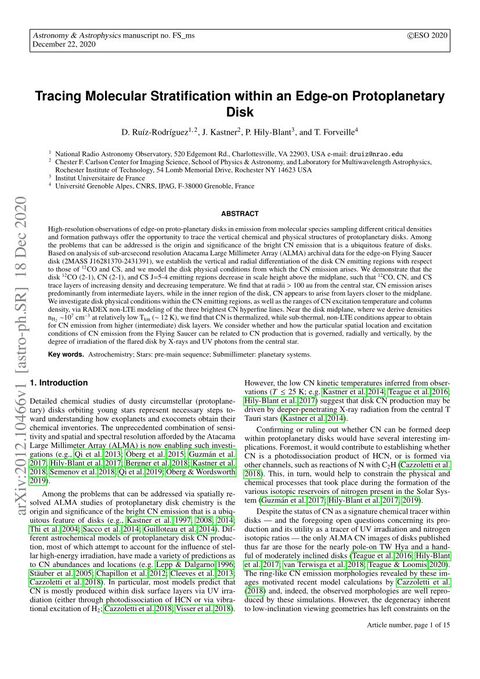
Tracing Molecular Stratification within an Edge-on Protoplanetary Disk
High-resolution observations of edge-on proto-planetary disks in emission from molecular species sampling different critical densities and formation pathways offer the opportunity to trace the vertical chemical and physical structures of p…
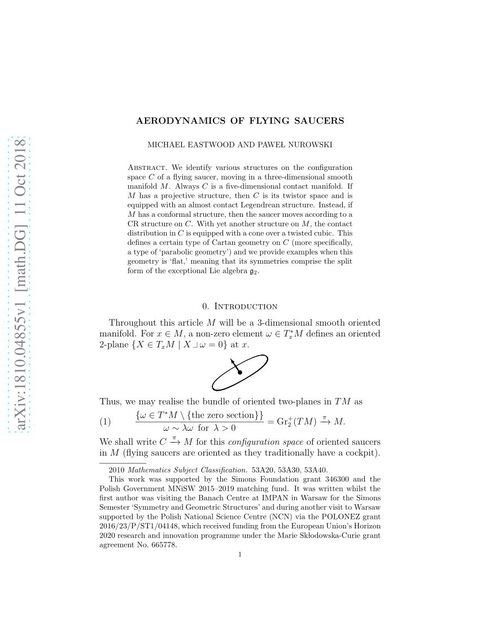
Aerodynamics of flying saucers
We identify various structures on the configuration space C of a flying saucer, moving in a three-dimensional smooth manifold M. Always C is a five-dimensional contact manifold. If M has a projective structure, then C is its twistor space …
Aerobatics of flying saucers
Starting from the observation that a flying saucer is a nonholonomic mechanical system whose 5-dimensional configuration space is a contact manifold, we show how to enrich this space with a number of geometric structures by imposing furthe…
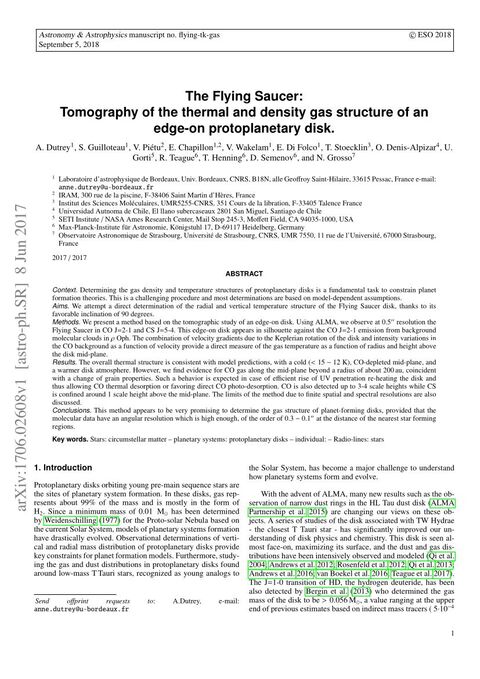
The Flying Saucer: Tomography of the thermal and density gas structure of an edge-on protoplanetary disk
Determining the gas density and temperature structures of protoplanetary disks is a fundamental task to constrain planet formation theories. This is a challenging procedure and most determinations are based on model-dependent assumptions. …
The shadow of the Flying Saucer: A very low temperature for large dust grains
Dust determines the temperature structure of protoplanetary disks. However, dust temperature determinations almost invariably rely on a complex modeling of the Spectral Energy Distribution. We attempt a direct determination of the temperat…
Spatial Point Pattern Analysis of the Unidentified Aerial Phenomena in France
We model the unidentified aerial phenomena observed in France during the last 60 years as a spatial point pattern. We use some public information such as population density, rate of moisture or presence of airports to model the intensity o…
Avrocar: a real flying saucer
One of the most unusual military aircraft programs V / STOL was the Avro VZ-9 "Avrocar". Designed to be a real flying saucer, the Avrocar was one of the few V / STOL to be developed in complete secrecy. Despite significant changes in the d…
Freezing of a Liquid Marble
In this study, we present for the first time the observations of a freezing liquid marble. In the experiment, liquid marbles are gently placed on the cold side of a Thermo-Electric Cooler (TEC) and the morphological changes are recorded an…
Supersymmetric Q Solitons of Arbitrary Genus
We construct "Flying Saucer" solitons in supersymmetric N=2 gauge theory which is known to support BPS domain walls with a U(1) gauge field localized on its worldvolume. We demonstrate that this model supports exotic particle-like solitons…
Deep Spitzer spectroscopy of the `Flying Saucer' edge-on disk: Large grains beyond 50 AU
We present deep Spitzer-IRS low-resolution (lambda/Delta lambda ~ 100) 5-35 micron spectroscopy of the edge-on disk ``the Flying Saucer'' (2MASS J16281370-2431391) in the Ophiuchus molecular cloud. The spectral energy distribution exhibits…